Foxl Makes the Phone Call for You
Ask in a chat and Foxl calls for you from your Mac through your iPhone, after you approve that one call. It says it is an AI assistant first, and the chat tells you how it went.
On this page
Foxl can make a short phone call for you. You tell it in a chat who to call and what you need, it shows you the call it is about to make, and once you approve, your Mac places the call through your iPhone. Foxl does the talking. It starts by saying it is your AI assistant, and when it hangs up it tells you in the chat what the other person said.
You need a Mac and an iPhone that allows calls on other devices, and the number has to be in South Korea, the US or Canada. The person sees your own number and the call is on your own phone plan. The voice runs on Amazon's speech models, on the AWS account set up on your computer or, on a computer without one, on your Foxl credits.
Asking for a call
Say you want a table for two tonight. You write it the way you would to a friend who offered to call for you: the restaurant, the number, the time, and that a window seat would be nice. Foxl does not dial yet. It checks the number, works out the most the call could cost, and puts a card in the chat that spells out the call it wants to make.
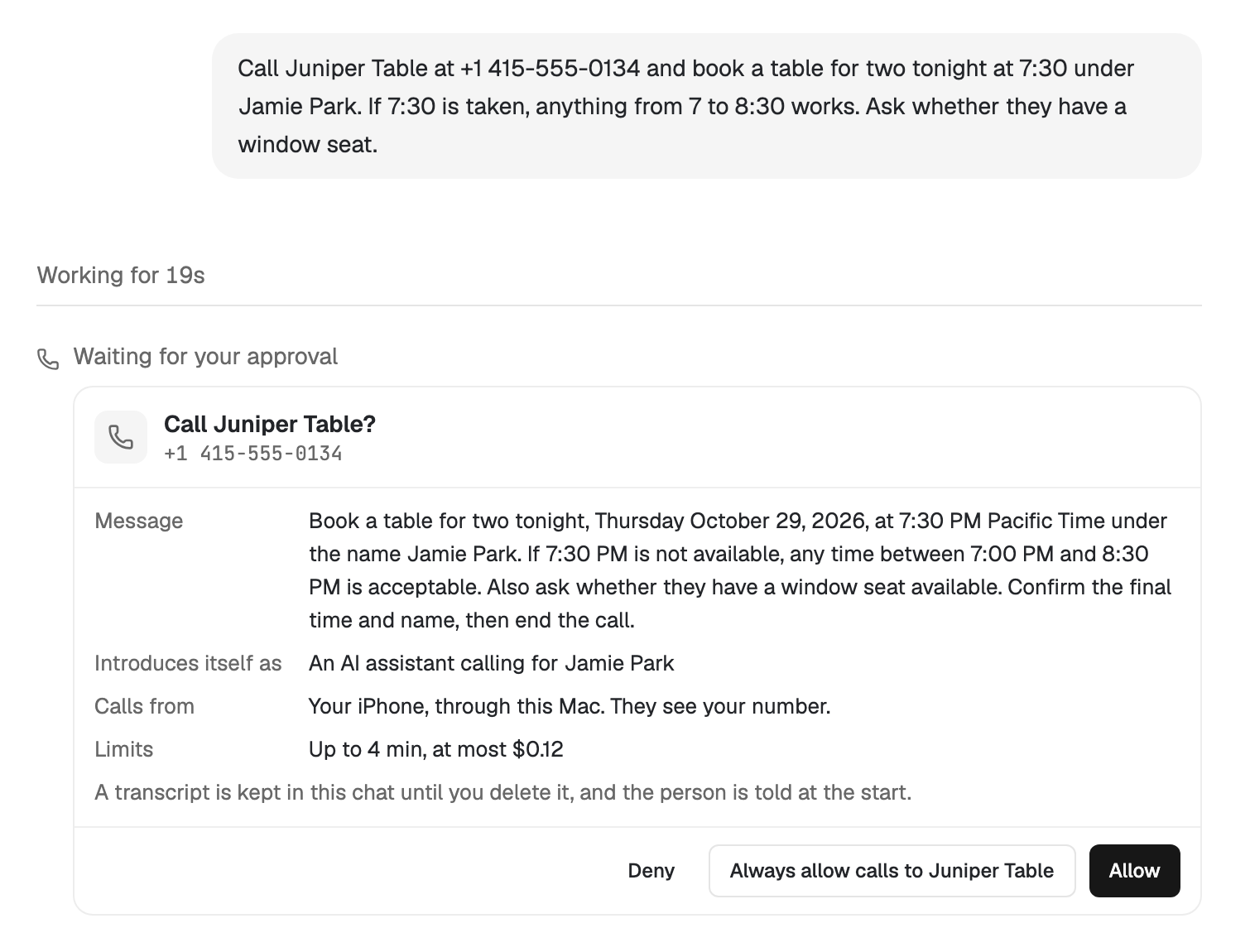
Everything you are agreeing to is on that card: the full number (the only place Foxl shows it unmasked), the message in the words Foxl will use, how it introduces itself, that the call comes from your iPhone, and the time and cost limits. If something is wrong, say so and Foxl prepares the call again. Allow places it and Deny drops it. One approval is good for one call, and a card nobody answers goes away after three minutes.
For a number you call often, Always allow calls to that person skips the card next time, for that one number only. The opening line, the limits and every other check stay the same, and Settings > Safety > Always-allowed calls is where you take a number back off the list.
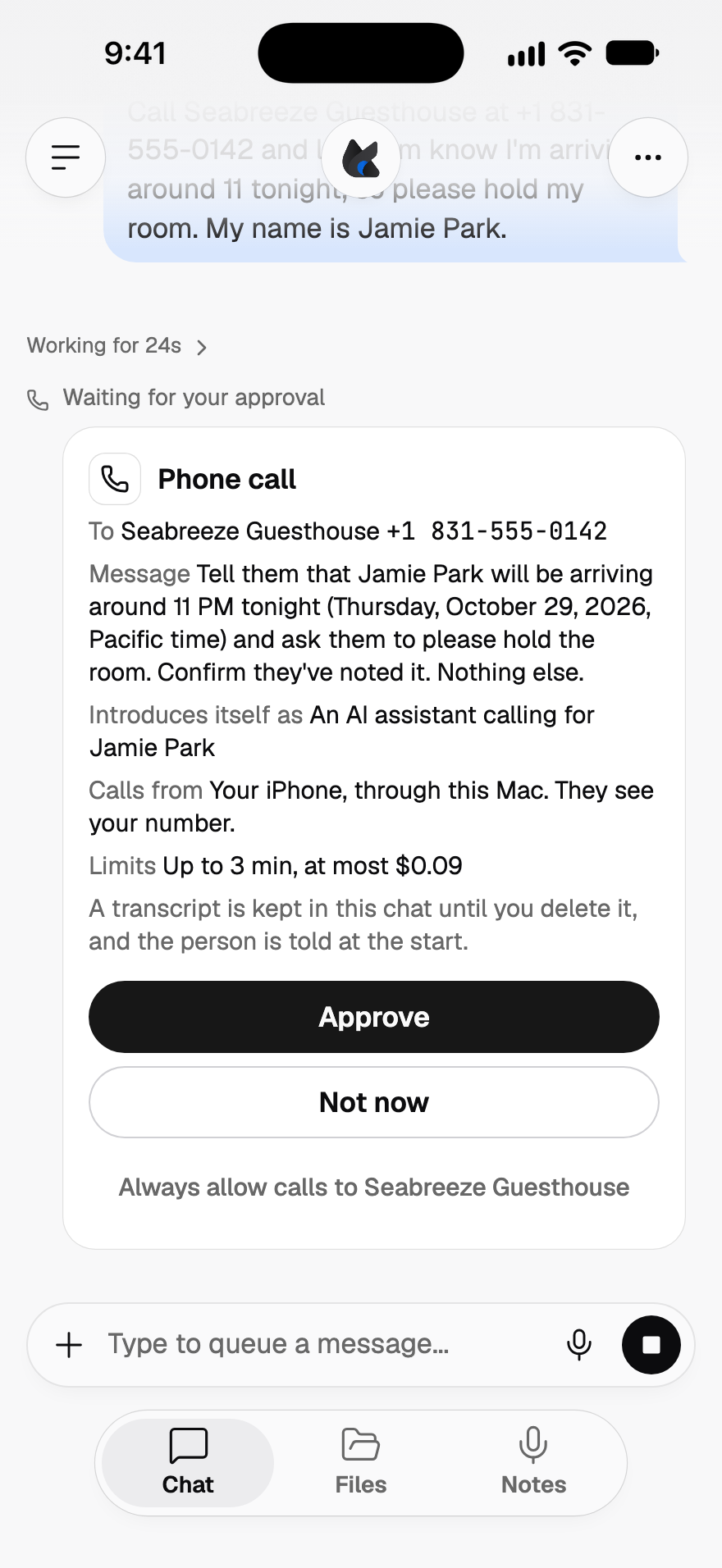
You can also ask from the Foxl app on your phone while your Mac is on. The card shows up there (with Approve and Not now), and the call still goes out from the Mac.
On the call
After you approve, the card follows the call through dialing and ringing, with a Stop call button that hangs up at any moment. When someone answers, Foxl opens with a fixed sentence that is never left to the model, so it cannot be talked out of saying who it is:
Hi, this is Alex's AI assistant. A transcript of this call is being kept. Am I speaking with the guesthouse?
It speaks the number's own language, Korean on a Korean number and English otherwise, unless you ask for Spanish, French, German, Italian, Portuguese or Hindi; then the whole call is in that language, this first sentence included. The middle sentence about the transcript is said on calls to the US and Canada; on a Korean number it is left out, and the card tells you instead that the transcript stays in your chat.
Next it says why it is calling and asks whether they have a moment, and it only goes on if they do. If they would rather not talk to an AI, it apologises for the interruption, says goodbye and hangs up. If a voicemail greeting or a phone menu picks up, it hangs up without leaving any details. When the conversation is done it says goodbye and waits a beat for the other person to say theirs, so the call does not end on a click. And if Foxl's connection to the voice model drops halfway through, it reconnects with the conversation so far and carries on, up to twice in one call.
The person on the line is not you, and Foxl treats them that way. It will make the booking you asked for, but it will not take on anything new from them: no payment, no different booking, no change to an account, no call to someone else, nothing more about you than the message says. It says so politely and offers to pass the request on.
After the call
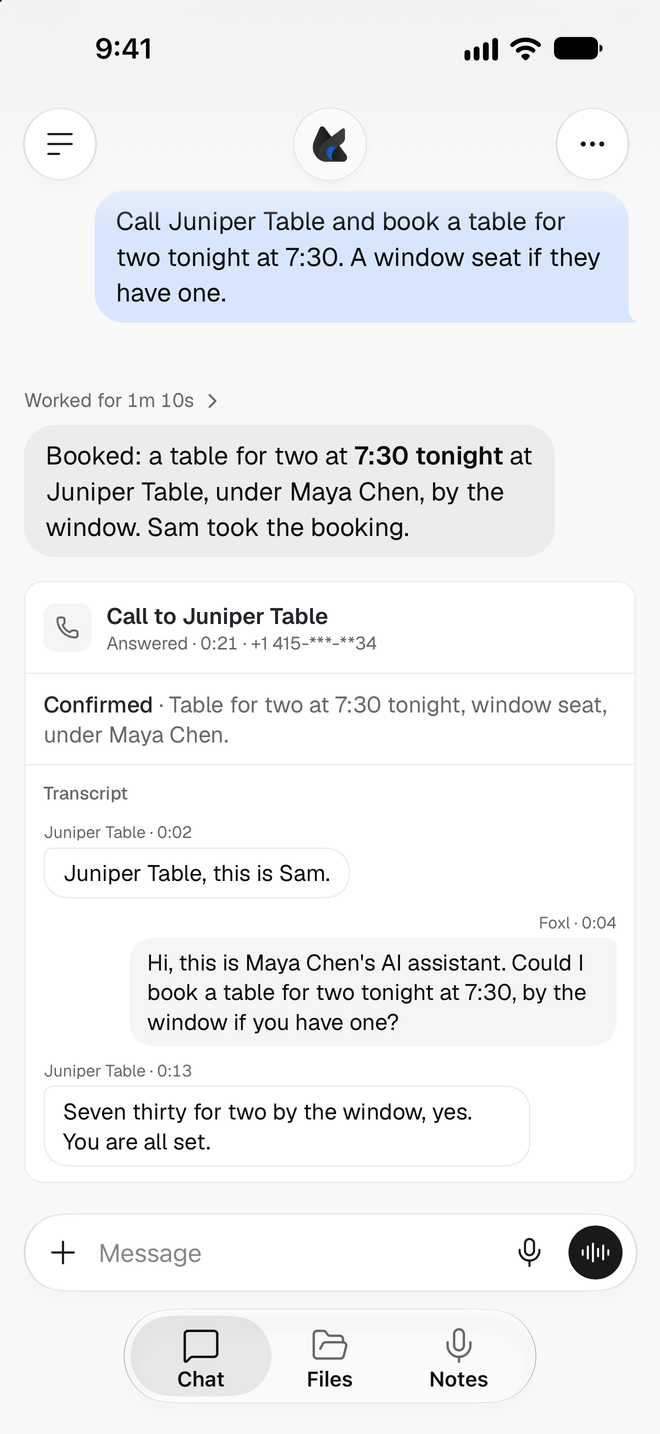
When Foxl hangs up, the card turns into a short report: how it went (Confirmed, Message delivered, Asked for a call back, Declined to talk with an AI assistant or No answer), one line of what they said, and the transcript. Foxl's reply above the card tells you where things stand and what, if anything, is left for you.
How a call is wired
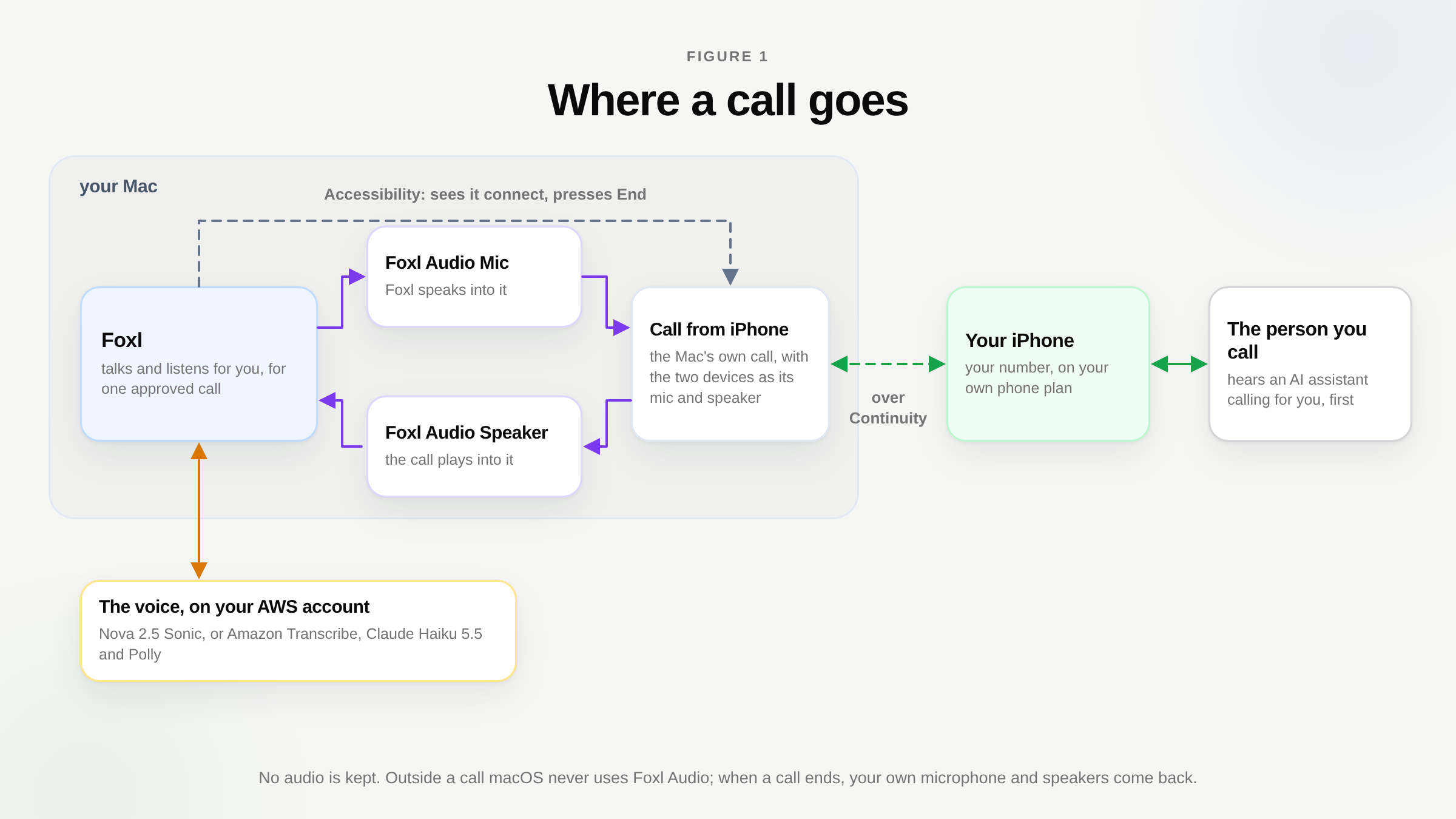
macOS gives apps no way to place, follow or end a call made through an iPhone. So Foxl uses the same Calls from iPhone feature you would use yourself, and sits where your microphone and speakers normally are. The Foxl Audio driver adds two audio devices to the Mac: one Foxl speaks into, which the call uses as its microphone, and one the call plays into, which Foxl listens to. Only during a call does the Mac use them. When the call ends, your own microphone and speakers come back.
To press Call and End, and to notice when the other side picks up, Foxl reads the call banner through macOS Accessibility. That is why it asks for the permission, and why it will not dial without it: a call it could not hang up is a call it does not start. For the length of each call it also turns on the macOS setting that makes the banner readable, and turns it back off afterwards.
The voice is Amazon Nova 2.5 Sonic on Amazon Bedrock, a model that listens and speaks in one step. For Korean you can switch to a chain of services AWS documents for Korean instead: Amazon Transcribe listens, Claude Haiku 5.5 decides what to say, and Amazon Polly says it. Either one runs on the AWS account set up on your computer. On a computer without one, it runs through Foxl's own cloud service on Foxl's AWS account instead, and your Foxl credits pay for it.
Setting it up
Settings > Phone calls has three rows. If you ask for a call before they are done, the same rows appear right in the chat.
- Foxl Audio, then Install. Your Mac asks for your password once.
- Accessibility, then Allow.
- Your iPhone. On the iPhone, open Settings > Apps > Phone > Calls on Other Devices, turn on Allow Calls on Other Devices and pick this Mac. On the Mac, turn on FaceTime > Settings > Calls from iPhone. Both need the same Wi-Fi and the same Apple Account.
The rows in the chat end with Voice account, which says whose account the voice will use: the AWS account on your computer, or your Foxl credits when it has none and you are signed in to Foxl. In Settings the same answer is the first row under Call voice.
Under Advanced voice options, Korean calls starts on Nova 2.5 Sonic. AWS does not officially support Korean on Sonic and says recognition and the voice can be less accurate in languages like that. We listened to both at phone quality and Sonic still sounded the most natural, so it is the default; Amazon Polly's Korean voices are the other choice in the same menu. Voice region on Auto picks the AWS Region that answers fastest from your computer; on Foxl credits the voice runs in the Region of Foxl's service.
How quickly it answers, and what it costs
Foxl starts replying about 1.5 to 2 seconds after the person stops talking. We measured the pieces separately in late October 2026, on simulated calls where Amazon Polly played a scripted Korean callee through 8 kHz phone audio, so the total is an estimate built from parts.
| Part of a reply | Measured |
|---|---|
| Nova 2.5 Sonic, from the person's last word to its first reply | 0.93 to 1.20 s over four turns |
| Foxl Audio and its helper, each way | about 0.15 s (median 155 ms) |
| The hop between the iPhone and the Mac | not measured yet |
| The whole reply on the Mac route | about 1.5 to 2 s |
Most of Sonic's second goes into deciding that the person has finished, and the AWS Region barely changed it. A quiet line mattered more. With the callee 28 dB quieter than normal, Sonic misheard them (a character error rate of 0.27); with Foxl levelling their audio first, it got every word of the test right (0.00).
The call itself costs whatever a call from your iPhone costs on your plan. When the voice runs on your own AWS account, it is billed there at a few cents a minute: a 31-second simulated call used $0.0077 of Sonic. The limit on the card budgets $0.03 a minute for Sonic and $0.05 for the Korean chain, a call's worst case has to stay under $1.00, and a call whose real usage runs past its estimate hangs up.
On Foxl credits the card's limit is in credits: a call holds about 1.39 credits for each minute it may last, so a 3-minute call reads "at most 4.17 Foxl credits", and you need that much to place it. Only what the call used is taken. The card shows it when the call ends, and the Usage Breakdown on your Account page lists it under Phone calls.
What it will not do
It will not call emergency or service numbers (112, 119, 911 and the like), premium-rate numbers (060 in Korea, 900 and 976 in North America) or anything outside South Korea, the US and Canada. Those are turned down from the digits alone, before a card appears.
It will not call on its own. A call starts only from a chat you are in; a schedule, a check-in, a channel such as Slack, the Notes assistant, the browser extension, a Foxl Code task and a subagent cannot start one. During the call the only thing it can do besides talk is hang up.
It never uses your voice and never says it is you, and it says plainly that it is an AI assistant whenever it is asked. Calls are short: 3 minutes unless you ask for more, 5 at most, one at a time and ten a day.
What is kept
No audio is recorded. What is kept is the transcript, as text in that chat, until you delete the chat. You can turn that off in Settings > Phone calls > Keep transcripts, or ask for a single call without one. The result card and Foxl's logs show the number with its middle digits hidden. For troubleshooting, Foxl also writes a small record of each call to its logs folder on your computer (timings, sound levels and how the call ended, with no audio, no words and no number), and sends it nowhere.
While the call is going, the audio goes to AWS for the conversation: from your computer, or on Foxl credits through Foxl's own cloud service, which keeps none of it. With Nova 2.5 Sonic, the default voice, that means Amazon Bedrock, which AWS says does not store or review customer speech.
Limits
Calls need a Mac with an iPhone. Windows and Linux have no way to call through your own phone yet, so the feature stays off there unless a developer switches it on with a Twilio account in the environment. Foxl presses the call banner's buttons by name, and it knows those names on a Mac set to English, Korean, Japanese, Chinese, German, French, Spanish, Portuguese or Russian; on a Mac in any other language it does not dial and says why.
From the Mac's side, a busy line, a declined call and a call nobody picks up look the same, so the card says No answer for all three. And a call is held in Korean, English, Spanish, French, German, Italian, Portuguese or Hindi only; ask for another language and Foxl tells you which ones it can use.
References and further reading
- AWS: Amazon Nova 2.5 Sonic AI Service CardDocumentation
- Download FoxlReference