Foxl v0.4.22: Claude Opus 5 Is the New Default
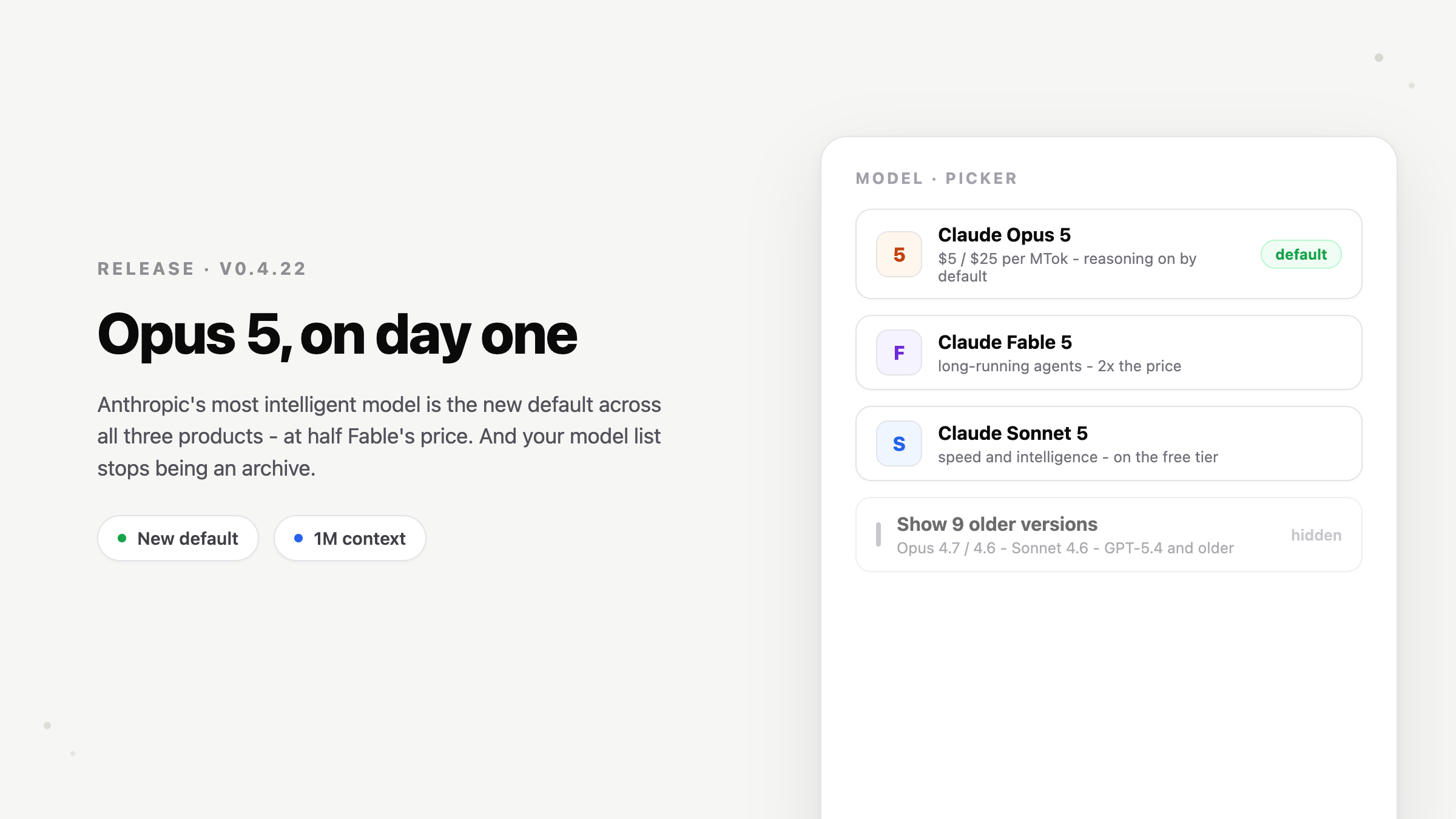
Claude Opus 5 is Anthropic's most intelligent model, and it ships as the default across Foxl Agent, Foxl Code, and Foxl Notes on day one - at the same price as Opus 4.8 and half of Fable 5. Auditing every model engine for the launch also turned up a Gemini CLI that returned empty replies to every request, aliases pointing at the wrong generation, and a pricing table in our own docs that was wrong by a factor of nine.
On this page
Claude Opus 5 is Anthropic's most intelligent model, and from day one it is the default in Foxl Agent, Foxl Code, and Foxl Notes rather than an extra entry in the model dropdown. It costs the same as the Opus 4.8 we were already paying for.
Why it becomes the default and not just another choice
A new flagship usually costs more than the model it replaces, so you pick it deliberately and use something cheaper the rest of the time. Opus 5 does not come with that tradeoff. It matches or beats Fable 5 on agentic coding and professional knowledge work at half Fable's list price, and it lands on exactly the same $5 in / $25 out per million tokens as Opus 4.8, which it supersedes. Staying on 4.8 would save no money at all, so there was no reason to make you choose between them.
It carries a 1M-token context window and up to 128K tokens of output. Reasoning is on by default: rather than you picking a thinking budget, Opus 5 decides for itself how long to think on each turn, and the effort control (low through max) sets the depth rather than switching it on. If you had reasoning configured before, your setting still applies.
One consequence broke code inside Foxl before we caught it: on Opus 5 a request thinks even when you did not ask it to, and the reasoning block can arrive before the answer text. Any code that grabbed the first block of a response and assumed it was the reply now gets a thought instead. We found and fixed two places in Foxl Notes where that would have produced empty summaries with no error.
Your model list stops being an archive
Every model we have ever shipped was still in every picker. Opus 4.7, Opus 4.6, Sonnet 4.6, GPT-5.4 and older, and Gemini 2.0 sat in the same fixed-height scroller as the models you should actually pick, so finding a current model meant scrolling past superseded ones.
Superseded models are now hidden by default across all four pickers: chat, Settings, Foxl Notes, and Foxl Code. Nothing was removed. A single switch - "Show older model versions" in Settings, or the one-tap row at the bottom of any picker - brings them all back, and it is one preference shared by all three products rather than four that drift apart.
The rules for what stays visible matter more than the hiding itself. A model you have selected is never hidden, because a picker that hides the model you are currently running just shows you an empty box. A model you have favorited is never hidden, because pinning something is a stronger signal than our tidiness default. Search always covers the full list: with the setting off, typing "4.6" still finds Sonnet 4.6. Hiding only changes the default view.
Haiku 4.5 stays visible, because it is the current fast tier rather than an old version.
Things that were quietly broken
Auditing every model engine for stale configuration also turned up bugs that were unrelated to old versions and had survived only because nobody checked.
Gemini CLI returned an empty reply to every single request.Foxl read the CLI's output stream in a format that CLI has never emitted, so every line of every answer was discarded and you got a blank bubble. Errors were hidden too: a quota or sign-in failure was indistinguishable from success, because the field we checked for "did this fail" is one the CLI never sets. We installed the shipping CLI and read its own event definitions out of the bundle to get this right rather than trusting documentation. On the way we also found that signing in with gemini was never detected at all - Foxl only looked for an API key, so a signed-in CLI still reported itself as not configured.
Some models were not the model you selected. Choosing the short "Claude Code Sonnet" option ran Sonnet 4.6 long after Sonnet 5 shipped, because its sibling Opus alias had been updated and this one had not. Six other model identifiers resolved to nothing internally, which made Foxl treat a 1M-context model as though it held 256K - compacting your conversation about five times earlier than necessary - and record its cost as zero. GPT models running on a ChatGPT subscription were assumed to hold 1M tokens when the service actually serves 272K, so long sessions failed upstream instead of compacting in time. A GPT-5.3 option that OpenAI does not serve at all has been removed.
Foxl Code was erasing your starred models. Foxl Code and Foxl Agent share one favorites list but stored it in two different formats, so opening Agent chat once unstarred everything you had favorited in Code, without any message.
Our own pricing documentation was wrong by 9x. The per-token credit table in the docs assumed one credit buys four cents of model usage. It buys $0.036 - there is a margin, and the table never accounted for it, so every row understated the real cost by a factor of 9.26. Both tables are recomputed from the actual rate, and the rate is now stated on the page so the arithmetic can be checked. We would rather publish a correction than leave a number that looks reassuring and is not.
Also in this release
Settings gained a Refresh button next to Save Provider Settings: after running claude /login or codex login outside the app, Foxl used to keep showing the old "not configured" state until you restarted it. Foxl Code now bills AgentCore compute properly - a task costs both the model tokens and the machine it runs on, and the machine half was never charged on relay-routed tasks. The Budget section lost two knobs that did nothing at all, and Runtimes now shows real live spend instead of $0.000 for the entire duration of a task.
On mobile, the starter prompts under the greeting now appear (they never had before), your last greeting is remembered so a cold start paints instantly, and tapping a product in the sidebar closes the drawer like every other destination in it. The chat send button is round now, matching Foxl Code.
References and further reading
- Foxl v0.4.22 changelogRelease
- Model documentationReference
- Download FoxlReference