Foxl v0.3.3: What "Day-One Support" Actually Shipped
A corrected release record for Fable 5: what Foxl integrated on June 9, why provider suspension was a separate state, and how a later Bedrock profile change forced routing to move from global to us.
On this page
Foxl v0.3.3 shipped the application-side work required to select and invoke Claude Fable 5. That statement is narrower than saying the model remained available. A product can have a complete integration while the upstream provider has suspended the model, a regional profile is unavailable, or an account is missing an entitlement.
The engineering lesson from this release is that a model name is only the first field in a distributed contract. Routing, request shape, billing, entitlement, and UI state all have to describe the same model version.
What v0.3.3 shipped
On June 9, Foxl added a canonical claude-fable-5 entry and connected it to the desktop agent, Foxl Code, Foxl Notes, the relay, and the Claude Code OAuth compatibility path. Opus 4.8 remained the default. Fable was an explicit Pro or Ultra selection.
| Contract | Launch responsibility | Failure if omitted |
|---|---|---|
| Identity | Map the Foxl model ID to each provider wire ID | Persisted selections or requests resolve to the wrong model |
| Reasoning | Send adaptive thinking and an effort value | Bedrock rejects the older budget-token request shape |
| Routing | Select an inference profile and matching signing region | The request fails before inference starts |
| Metering | Register explicit input, output, and cache prices | Usage falls through to an unrelated default price |
| Entitlement | Apply plan and provider-account requirements | The picker advertises a route the account cannot use |
The launch-day routing contract
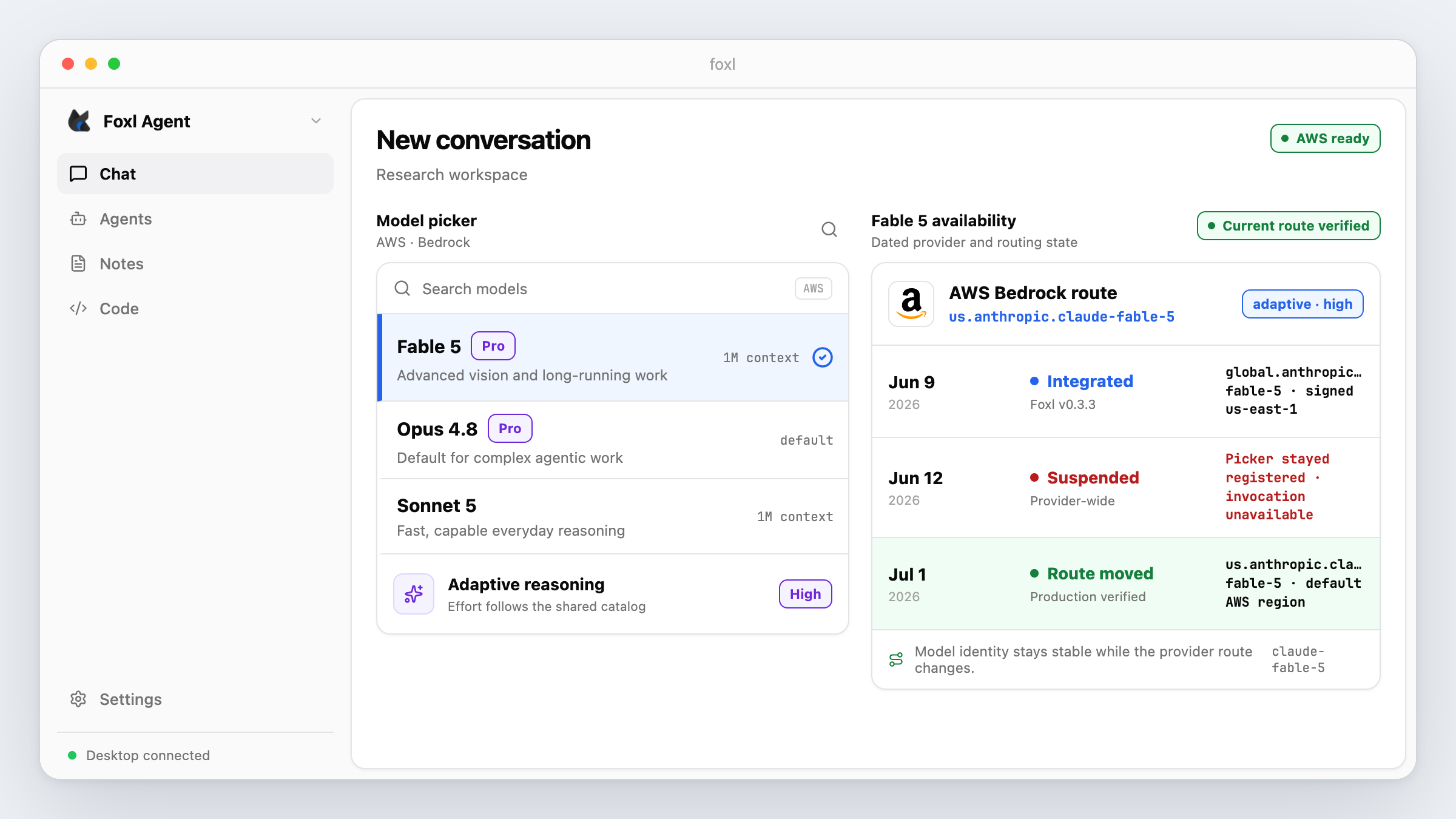
The Bedrock path that worked in Foxl's production account on June 9 usedglobal.anthropic.claude-fable-5 and signed requests inus-east-1. The account also needed the provider data-sharing setting enabled in that region. The ordinary us. profile was not a valid route at launch.
Signing region and endpoint region must move together. Pinning only the model ID, or only the AWS client, produces a request that is internally inconsistent. Foxl therefore treated the source region as part of the provider mapping rather than as a UI preference.
launch route
model profile: global.anthropic.claude-fable-5
source region: us-east-1
reasoning:     anthropic-adaptive
Why request shape belonged in the catalog
Fable accepted adaptive thinking and rejected the olderthinking.type: "enabled" shape. Foxl initially had model-name checks for known Opus and Sonnet versions. A new family name fell through that condition and received the wrong request.
The repair moved the decision to a typed capability in the shared model catalog. Callers ask for the model's reasoning style instead of inferring behavior from a substring. With the capability in the catalog, adding a new model means declaring its protocol instead of finding every regular expression that matches older model names.
thinking: {
  style: "anthropic-adaptive",
  defaultEffort: "high"
}
Availability changed after the release
- June 9: Foxl v0.3.3 shipped the model registration and completed a production relay invocation through the launch route.
- June 12: the provider suspended Fable 5 and Mythos 5 access across providers. Fable remained registered in the v0.3.12 source, and the repository records no June 12 picker-removal change. No client update could make an upstream-suspended model servable.
- July 1: production verification showed the routing state had inverted. The standard
us.anthropic.claude-fable-5profile streamed from both tested US regions, while the oldglobal.profile returned server errors. Foxl v0.3.24 switched tous.and removed the mandatory region pin.
The July change retained an environment override as an operational escape hatch, but the normal path once again used Foxl's default Bedrock region. This was a routing change, not a claim that a model endpoint can never be suspended again.
What the release process changed
A launch check now needs more than a successful picker render. The minimum evidence is a real invocation through each supported transport, the exact request shape, an explicit price row, entitlement behavior for allowed and denied accounts, and a way to disable selection without shipping a new desktop build.
The release history remains available in the Foxl changelog. Provider setup and current authentication paths are documented in the provider configuration guide.
References and further reading
- Model providers and authenticationDocumentation
- Current Foxl model catalogDocumentation