The Checksum Byte That Ate Your Long Answers
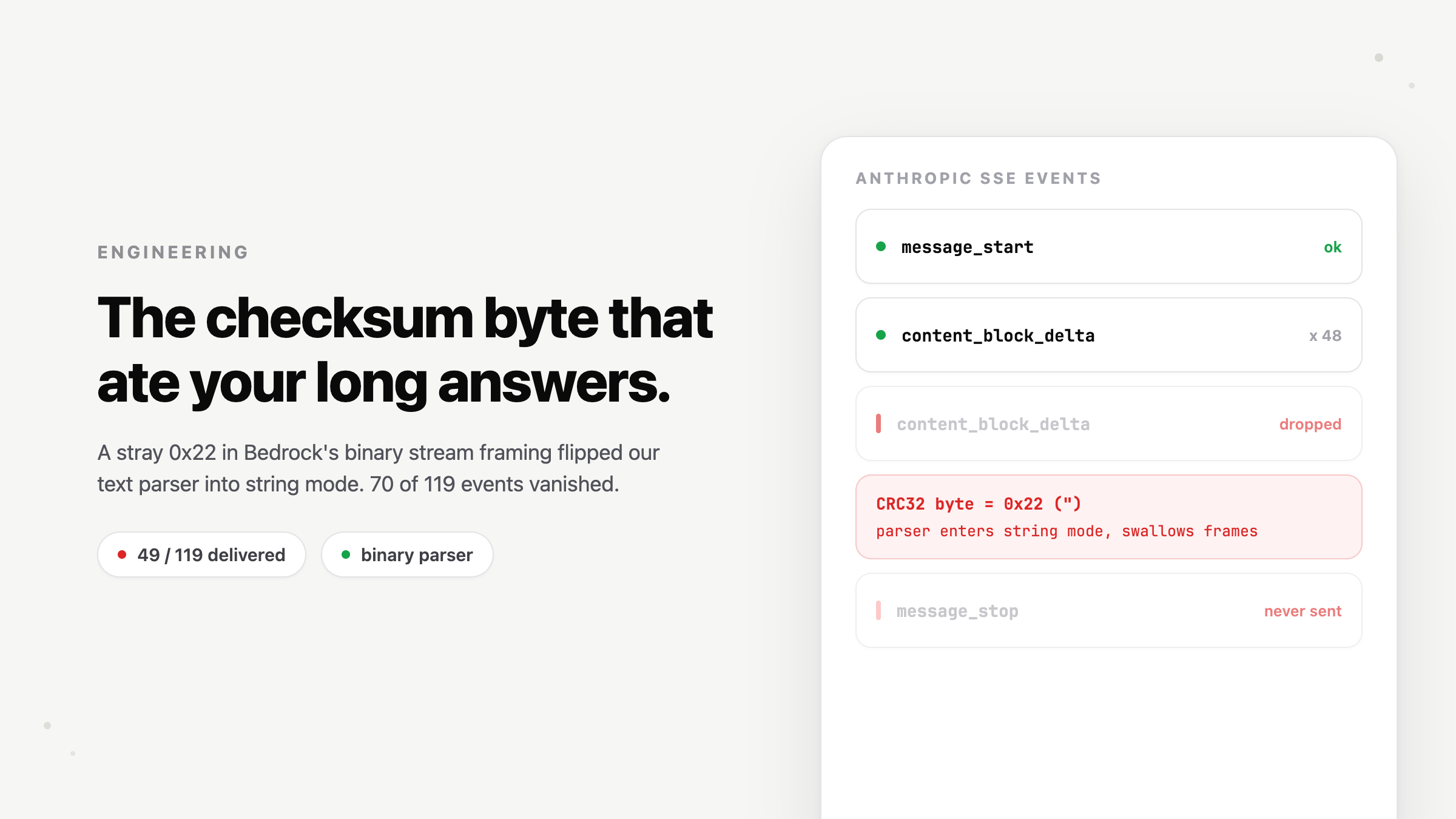
Long Foxl replies were cut off because the relay decoded Amazon Bedrock's binary event-stream as text and scanned it for JSON braces. A framing byte equal to 0x22, a double quote, could put the scanner into string mode, and on a captured 32 KB stream it lost 70 of 119 events. This covers the length-based parser that replaced it and the fixture test that pins it.
On this page
Incident summary
The relay truncated some Bedrock responses because it decoded an AWS event-stream body as UTF-8 and searched it for JSON objects. The payloads were JSON, but the enclosing protocol was binary. Length fields and checksums could therefore change the text scanner's state and prevent later events from being emitted.
The replacement parser consumes declared binary frame lengths from a rolling byte buffer. A captured 32,254-byte Bedrock stream is the regression fixture. It contains 119 messages, all of which are recovered with no leftover bytes under the tested chunk boundaries.
Impact
Once the text scanner lost framing alignment, later content deltas and terminal events were not forwarded. The client received a valid prefix but not the complete response or its final message_stop. A related boundary defect could discard a partial JSON object between reads, corrupting streamed tool input before the binary parser was introduced.
The protocol on the wire
Bedrock's InvokeModelWithResponseStream APIuses vnd.amazon.eventstream. The Amazon event-stream encoding specification defines each message as a 12-byte prelude, optional headers, a payload, and a trailing checksum:
[4B total length][4B headers length][4B prelude CRC]
[headers][payload][4B message CRC]
On the Claude path, the payload is a JSON wrapper whose bytes field decodes to an Anthropic event. On the ConverseStream path, the payload is the Converse event body and its event name is stored in the :event-type header. Both paths use the same outer binary framing.
Root cause
The old parser tracked braces, quotes, and string state over the entire decoded response. That model assumed bytes outside a payload were harmless text, which binary framing does not guarantee. A framing byte equal to 0x22 looked like a quote, and 0x7B looked like an opening brace. Either value could make real payload boundaries disappear inside the scanner's state.
The captured fixture documents 956 quote-valued bytes and 121 opening-brace-valued bytes in its framing. The incident record shows the text scanner dropping 70 of the 119 messages. Retaining a partial text object between reads, as covered byINC-014, fixed one boundary loss but could not make binary framing safe to scan as text.
Resolution: rolling binary parsing
extractEventStreamMessages receives a Uint8Array containing the previous unconsumed tail followed by the next network read. It parses only complete messages:
- Keep the entire buffer when fewer than 12 prelude bytes are available.
- Read the total and header lengths as big-endian unsigned integers.
- Leave a declared frame untouched when its final byte has not arrived yet.
- Slice headers and payload by offset, then advance by the declared total length.
- Return every complete message and the unconsumed tail for the next read.
const { messages, rest } = extractEventStreamMessages(buffer);
buffer = rest;
The payload-only wrapper serves the Claude InvokeModel path. The header-aware result serves ConverseStream models by decoding :event-type while skipping other AWS header value types at their declared widths.
Frame bounds and CRC limitation
The parser accepts a declared total length from 16 through 8,000,000 bytes. It stops without consuming data when the value is smaller, larger than that 8 MB bound, or when the declared header length exceeds the total length. It also stops when the complete frame is not yet buffered. Because a binary stream cannot be safely resynchronized from an arbitrary byte, the parser does not guess a new starting offset.
The current parser does not validate either CRC. It skips the four-byte prelude CRC and excludes the four-byte message CRC from the payload, but it never computes or compares their values. INC-021 makes this explicit by constructing frames with both CRC fields set to zero and expecting them to parse. The 8 MB bound is therefore a framing sanity check, not an integrity check. A frame with plausible lengths and an invalid CRC is not rejected today.
Test evidence
INC-017asserts that the decoded fixture is exactly 32,254 bytes and yields exactly 119 messages.- Chunk sizes 16, 64, 256, 1,024, 4,096, and 32,254 bytes each recover all 119 messages with zero leftover bytes.
- One-byte reads force every frame across many boundaries and still recover all 119 messages with zero leftover bytes.
- The recovered sequence contains one
message_start, onecontent_block_start, 114content_block_deltaevents, onecontent_block_stop, onemessage_delta, and onemessage_stop. - An incomplete eight-byte prelude is returned intact as the tail. A 64-byte corrupt prelude with an out-of-range length stops without throwing or consuming bytes.
INC-014retains split JSON objects, including tool input divided across repeated 37-character reads.INC-021recovers all seven header-aware ConverseStream events at chunk sizes 1, 4, 16, 64, 256, and the complete stream length.
Current guarantee
The covered guarantee is boundary-safe parsing for valid-shaped frames whose declared lengths are within the configured bound. The regression suite covers the captured Claude stream, pathological single-byte reads, and header-aware ConverseStream frames. CRC integrity remains outside that guarantee until checksum validation is added.
References and further reading
- Amazon event stream encoding specificationReference
- Choose and configure models in FoxlDocumentation