Designing Connection Ownership for Always-On AI Agents
v0.4.7 fixed duplicate device sessions and fenced stale desktop sockets, then v0.4.8 and v0.4.9 exposed the missing distinction between liveness, connection-generation ownership, and in-flight request correlation. This is the full incident sequence and the contract that replaced it.
On this page
Incident summary
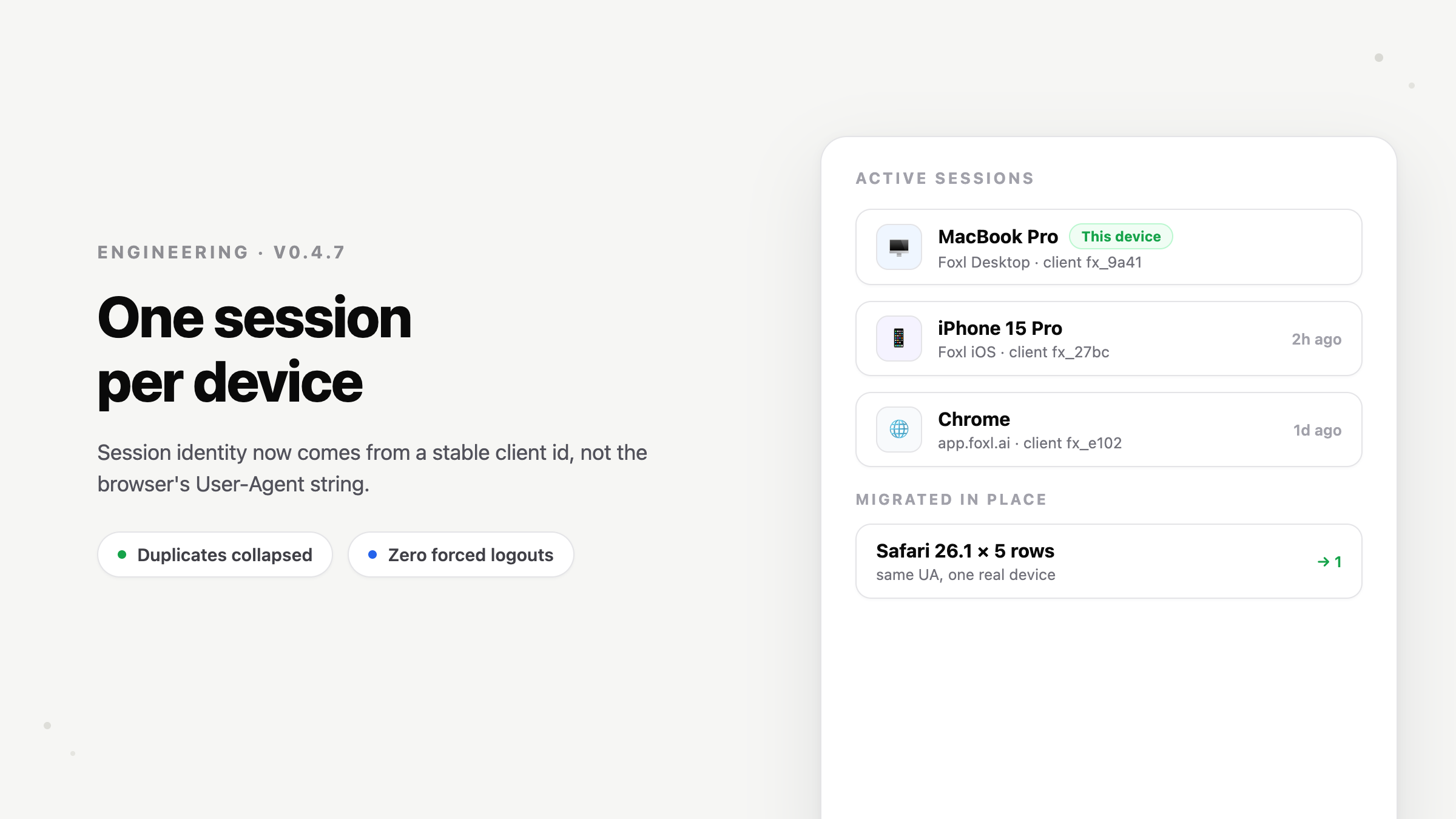
Foxl v0.4.7 replaced User-Agent-based session labels with a stableclient_id for each installation and browser profile. It also introduced connection fencing for the desktop tunnel. The identity change fixed duplicate account sessions, but the tunnel work exposed follow-on regressions in v0.4.8 and v0.4.9.
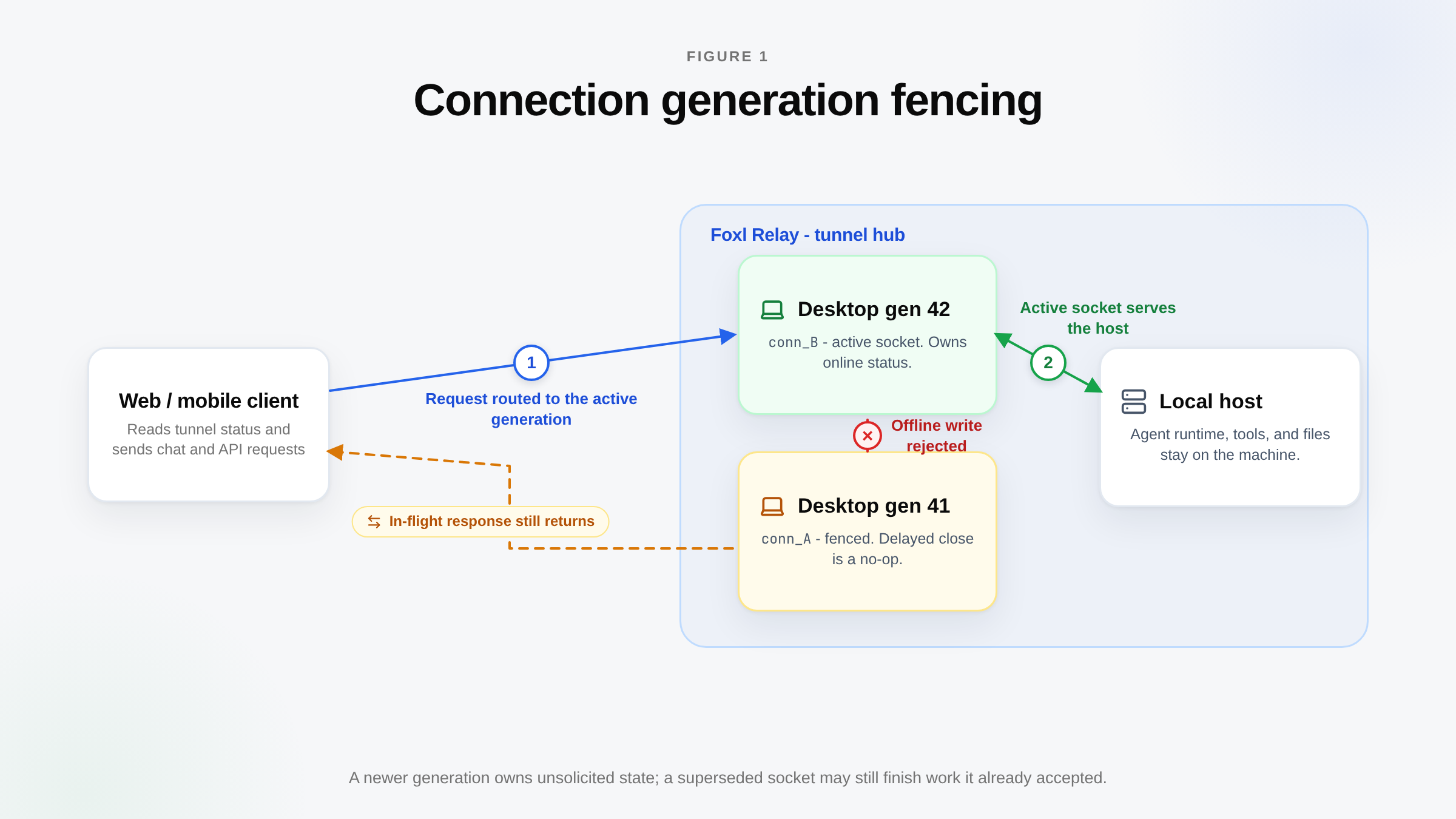
The underlying mistake was treating device identity, connection ownership, and request ownership as one problem, when they are three separate ones. A stable client identity answers which installation signed in. A connection generation answers which socket may publish new state. A request id answers which socket may finish work that was already dispatched.
Impact
Before v0.4.7, the Account page derived session labels from User-Agent strings. The same installation could accumulate rows after logins or client changes, while two machines running the same browser version were difficult to distinguish. Revocation therefore operated on a session list that did not reliably represent devices.
The tunnel regressions had different symptoms. In v0.4.8, a stalled desktop loopback call could leave the relay waiting for its 10-second request timeout while status still showed the desktop as connected. In v0.4.9, reconnects could accumulate web-client rows, abort requests already in flight, and recycle a healthy status socket during token refresh or app resume.
Release sequence
v0.4.7: stable identity and initial fencing
Each installation and browser profile began sending a stable client_id on login and refresh. Existing duplicate rows could collapse to that identity, and revocation could target one installation. Concurrent refreshes from two app surfaces also became idempotent within a short concurrency window instead of being mistaken for refresh-token reuse.
The tunnel assigned each desktop WebSocket connection a connection_id. Offline writes were conditional on that id, so a delayed close from an older socket could not clear the replacement socket's online state.
v0.4.8: bounded local calls
When the desktop exhausted local network ports, its call to the local Foxl server could stall without producing either a response or an error. v0.4.8 bounded that call and returned an explicit failure. It also corrected response matching so a desktop reply could still find its pending relay request after a reconnect.
v0.4.9: reconnect ownership
The next release closed three remaining reconnect paths. The relay now preserves and forwards the web client fingerprint, then replaces the prior socket with the same fingerprint. A new desktop generation no longer fails every pending request merely because it connected. The web app also keeps a healthy status socket open across token refresh and resume, a lifecycle boundary discussed in the desktop agent field guide.
The correction was narrower than removing fencing. Superseded sockets must not publish unsolicited state, but a superseded socket may still carry the valid response to a request that was sent before the reconnect.
The current three-part contract
- Liveness. An HTTP heartbeat updates recency, but it does not mark the tunnel online. If D1 says a device is online,
/tunnel/statusconfirms that state against the Durable Object. New desktop clients send a WebSocket heartbeat every 45 seconds; Cloudflare records the automatic response timestamp, and the production freshness window is 115 seconds. Older clients without that timestamp fall back to the socket's open state. - Generation ownership. One desktop connection id is active. A new generation fences older sockets from unsolicited messages and status changes. A delayed close from an inactive generation is a no-op. For a generation-tagged socket, D1 can clear online state only when the stored connection id matches. If the active generation closes, the hub may promote a healthy fenced fallback.
- In-flight request correlation. HTTP requests, chat streams, and API streams are tracked by
requestId. A response with a still-pending id is accepted from the socket that received the work even if that socket has since been fenced. An unmatched message from an inactive socket is discarded.
if (!correlatesToPending && !isActiveDesktop(ws)) return;Regression evidence
INC-020 verifies status truth. A paired device with no desktop WebSocket remains offline after three HTTP heartbeats, and /tunnel/status agrees with/tunnel/api: status is offline and the API returns503 OFFLINE. The same suite verifies that a live desktop socket reports online, pushes online and offline transitions, and becomes offline when its WebSocket heartbeat timestamp goes stale.
INC-023 verifies generation and correlation behavior. It closes the active generation and confirms that a healthy fenced socket is promoted. It verifies that a remote disconnect closes both active and fallback sockets, repeated web connects with one fingerprint do not accumulate client sockets, and an API response from the original desktop still completes after a second desktop connects.
Result
One session per device is an identity invariant, not a complete tunnel design. The current implementation keeps that invariant separate from live-socket truth, active-generation ownership, and response correlation. Reconnects can replace ownership without rewriting device identity or discarding work that the previous generation already accepted.
References and further reading
- Foxl security modelDocumentation
- Foxl v0.4.7 release recordRelease